Monday, 7 August 2017

Searching for ancient microscopic worm eggs

I've spent the last couple of months working on getting DNA out of our grave soil samples and identifying it. The idea is that, by having a computer search through data, archaeologists of the future will be able to avoid searching for worm eggs laboriously under a microscope. Out of interest though, we had a go at searching for worm eggs laboriously under a microscope.

Separating potential eggs from the rest of the soil is complicated. We ended up using a combination of methods that culminated in several little tubes of soil solution, each capped with a glass cover slip. The lightest material would float up over time and land on the slip. After leaving them overnight, we put the slips on microscope slides and (very very) carefully carried them up from the basement lab to the seventh floor, where the microscope lives.

It’s a very nice microscope. It connects to a computer, so Smith and me could do it together. She mostly operated the microscope while I snapped pictures of anything remotely interesting. Here are some of the highlights.

First, what's probably an ascus. This is a spore capsule from an ascomycete fungus. Ascomycetes are one of the main groups of fungi, containing all sorts of things from yeasts and lichens to some of the mushrooms.

Two tiny lumpy things that we thought might have been eggs before we figured out how to make a scale bar. They're both too small, really.

A strange, three-part object that I found over a dozen of across two sites. It looks like something germinating. Sometimes the central part was quite long, making the whole thing into a U-shape.

 A couple of moss spores. There were lots of these. We got quite excited when we first saw them, as they're about the right size and shape for some types of worm egg, but alas, they're definitely moss.
Finally, something that I thought was a moss spore too, but Supervisor noticed looked a little different:

I've yet to confirm, but this might be an egg. Perhaps. I'm going to track down the parasite curator this week and see if I can get her expert opinion.

Saturday, 15 July 2017

Kew Gardens in the rain

My day

After living just 9 km away from it for the best part of nine months, I finally got around to visiting Kew today. The weather wasn't great, but it was massive and impressive and my NHM badge got me in for free! The museum has this partnership with many institutions around the world, allowing staff to visit around as they please. Try not to think too hard about the fact that the NHM is free anyway.

I had an interesting walk through West London on my way there. I quite like wandering through residential areas, but the Chiswick Roundabout (which has its own Wikipedia page) manages to have a huge number of pedestrian crossings and still be terrifying. The silver lining was that my route led me over the roundabout itself, where I found its art installation:


Inside Kew, my first stop was a lovely medicinal garden in which my nice camera died. By the time I realised I had an auxiliary camera, I was in the bamboo garden, so that is where our tour begins. The centrepiece of the garden was a house:

Built in Japan something like 100 years ago, it demonstrated some of bamboo's many, many uses. The walls were equivalent to wattle and daub, and the roof was a very impressive structure supported by massive poles:
I took so many photos of this. Clearly spent too much time with engineering students.
I then left this exotic masterpiece for ancient British woodland, when it appropriately began to rain. It drizzled on and off all day. I met other tourists flapping with raincoats and ponchos and exchanged wry smiles of solidarity. I also, by huge coincidence, met one of my housemates and her parents sheltering in an art gallery. But we're not here to talk about art.

According to the map, on the way to the ancient woodland was a giant badger sett. I've never seen much of badgers so this was exciting. It wasn't quite what I expected.


Note: not a real badger

Fun though! Even if it was quite a squeeze to get in, and I'm only a medium-sized human.

But there were real animals:
See the scaffolding around the pagoda in the background? There was quite a lot of restoration work going on. The good news was that, with closures, I had time to see nearly everything else in one day.

This included the treetop walkway...


...which was a bit scary because the metal was bending under my feet.
I tried to stay on parts that looked like they'd at least heard of safety regulations

After a lot of wandering around, happily eating sandwiches in the rain, I popped out next to that iconic Kew building, the palm house:

The front was a very neat walkway with sculptures and benches. There are benches everywhere, which was great, and most of them are dedicated. This was my favourite:
Eyes watering already
Unfortunately, I didn't get to see the palm house as well as I'd have liked because I wear glasses, which went opaque. But there was another impressive tall walkway, and I blearily found some really cool plants. For example, behold the Cavendish banana, through which humankind is held on a global banana precipice:

Then I crossed over to the other enormous glasshouse open today, the Princess of Wales Conservatory. Smith (doing London to the max) went to Kew the other week and said that this was not to be missed. She was quite right. It's truly massive, showing a variety of warm to tropical climates with a huge number of plants. Some highlights:

Welwitschia (named after a Mr Welwitsch):

Pebble plants (Lithops, meaning 'face of stone'):

And the titan arum (Amorphophallus titanum, meaning 'giant oddly-shaped penis'):
Quite right too
 There was also a great series of tanks and ponds for aquatic plants... and fish! As much as I've embraced botany over the years, they can't compete with fish. There was a chillaxed pufferfish!

And several giant, giant fish of which one was a carp and another was a dazzling catfish and none I photographed adequately.

Another fish I didn't get a picture of was the piranha. It was hanging out at the back of its tank when I arrived. A lady was telling a small child about its vicious reputation. I mentioned that, when my friend was there recently, the piranha had been chasing visitors as they passed the tank. Not today. I moved on. I looked back to see the child pressing a teddy up against the glass and the piranha was suddenly incensed.


After that wonderful glasshouse, I popped into the little alpine section and was surprised to see evidence of Teletubbies in captivity:

And, after more wonderful outdoor gardens, took my final photo in the bonsai house, bringing this pixel-heavy story to a circular conclusion:
It's a juniper. I adore dinky things; apparently this extends to trees too.

In conclusion: bravo, Kew. Though I can't comment on your value for money, hooray!

Anting

I was going through photos to put on here when I found one from a few weeks ago. Take a look at this magpie:


From what I can tell, it was sitting and wriggling on top of an ant nest. It was probably anting. This is where the bird deliberately gets ants into its feathers; Wikipedia (https://en.wikipedia.org/wiki/Anting) tells me that nobody can quite agree what anting is for, but it might be to do with cleaning. Ants spray defensive chemicals which might help kill parasites. Spicy.

Sunday, 2 July 2017

Fossil hunting in Folkestone

In the first of a couple of very overdue posts, let me take you back to the end of May. The weather was beautiful and I was just starting out in the DNA lab. One weekend, me, some classmates and my not-biologist let's-see-what-all-the-fuss-is-about partner took a train to the south coast for a day of fossil hunting.

In previous years, my course had had a field trip to Folkestone, it being relatively close to London and very beginner-friendly. The main fossil formation is the Gault Clay, which is choc-a-block with marine inverts. But this year there were far too many of us. As it happens, I'd done an internship the other year curating Gault fossils with the highly knowledgeable Phil Hadland (https://sites.google.com/site/philhadland/ - I include a link because apparently Phil shares his name with a semi-famous footballer). Not only does he know his stuff, he's based in Folkestone and does guided walks. With his help, I organised an unofficial trip down anyway.

We started with a look around the brand new museum (http://www.folkestonemuseum.co.uk/), which had opened just the day before. It's a lovely space. While having lots of family-friendly interactives like all new galleries nowadays, it still managed to fit it a large number of specimens, especially for its size. We saw some spectacular examples of the sorts of fossils we'd be looking for.

After lunch on the beach in glorious sunshine, with a couple of my more daring colleagues taking a swim, we met up with our guide for the afternoon. I'd hoped that Phil could show us his local patch himself, but he was working in the museum, which understandably took priority! Instead we had Ian, another local fellow who'd been studying the area for most of his life, with an interest in butterflies and moths as well as fossils. We took the long way to the beach, taking in wildlife as we went. I think it's important for us to be naturalists as well as biologists. Biology is such a huge field, it's easy to get sucked into a speciality and forget that, for example, newts are awesome. I regret not getting a photo of the newt.

Ian gave us a short primer on the things we'd be looking for, aided by some of his own collection. Then we set out! The Gault Clay itself is at the back of the beach and fossils are eroded out and mixed in with the beach pebbles. Unfortunately, a combination of tides and trains meant we never managed to make it to 'the reef', his prime collecting site a bit further out, but for me just the beach was unbelievable.You'd look down and, underneath the top layer of large pebbles, every patch you dug through had something. I can see how people have spent their whole lives collecting there: there's just so much.

Towards the end, some of us scrambled around in the clay cliffs. The fossils are quite different up there. Because they've only just been exposed, the fragile parts remain; the downside is that a lot of the things you find are extremely fragile. One of us found a beautiful ammonite up there, nearly complete, but I'm just as happy with my pile of vaguely shell-shaped rocks that are more likely to withstand being forgotten about.

Gault fossils tend to come as these two main types. The prettiest are made of light grey clay with a fragile shell covering. The others are usually black phosphatised casts, where the original animal was buried but then dissolved away, with the space filled by another material. Casts aren't nearly so detailed but phosphate is nigh indestructible. However, beach fossils can also be made of pyrite. Pyrite reacts with oxygen in the air, especially humid air, to make sulphuric acid, which eventually eats the fossil, its label and quite possibly its container. Pyrite decay, as it's called, is unstoppable, but it can be delayed for a decade or so by painting clean fossils with clear nail varnish. Fortunately, most of mine are phosphate with just a lick of pyrite in some nooks and crannies, though even when I collected them those bits were orange with rust.

Anyway, here they are! I remember some names from when I studied Gault fossils with Phil, but most identifications were from this helpful website: http://www.gaultammonite.co.uk/
 
It's a shame it hasn't come out in the photo, but the two leftmost chunks are from the cliff clay and retain some iridescent aragonite.
Hamites is a genus of straight ammonite. These weren't coiled, but mostly U-shaped.

The other common cephalopods are the squid-like belemnites. The bullet-shaped parts are the equivalent of cuttlebones. This species comes in three varieties.


Occasionally there are more sedentary molluscs. This is a sea snail.


Even more molluscs: the most common beach fossils are inoceramid bivalves.

A similar species, but looking more like a toenail.


A mysterious one. I found non-inoceramid bivalves tricky to identify.

The two white fossils still have their chalky shells. The little black one is a phosphate cast.

Yep, not all corals form reefs. 100 million years ago, solitary corals were still in fashion.

Crinoids are like feathery starfish on a stalk. The fossil is a short segment of the stalk: a little stack of star-shaped ossicles.
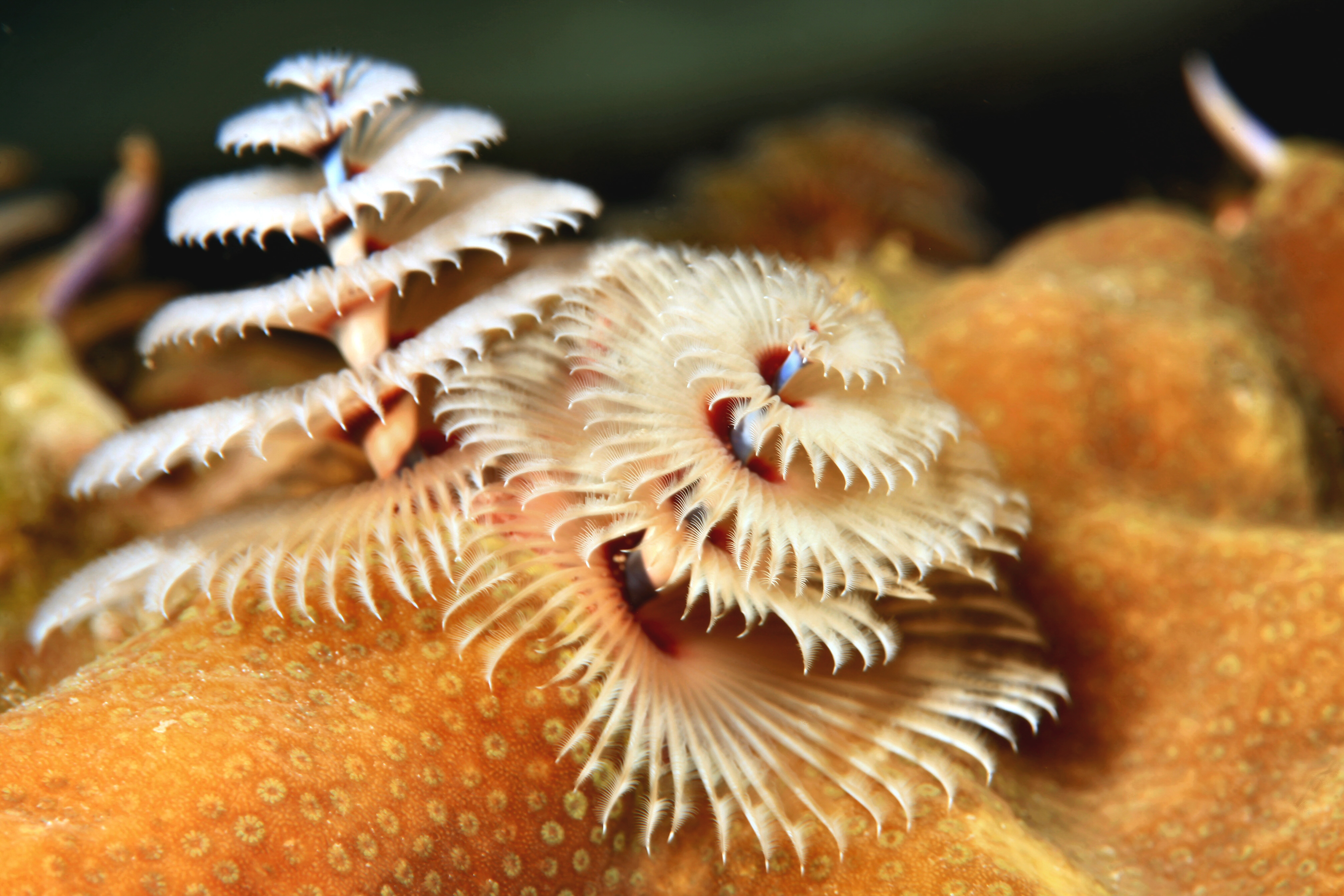
Fossil serpulid worms are a bit of a mystery, because you really can't tell what the worms look like from their tubes, which is all that remains. Modern serpulids include the delightful Christmas tree worm: https://upload.wikimedia.org/wikipedia/commons/3/35/Have_a_Holly_Jolly_Christmas_Tree_Worm_%285287830740%29.jpg

Brachiopods, which look a lot like the totally-unrelated bivalves, are rare in the Gault. I've seen a round, teardrop-shaped one before, which is what might be inside this lump of very hard rock. But I don't think I'll ever get it out.

Finally, one for all you botanists out there. Wood isn't particularly rare, but it is often brittle and disintegrates easily. I was lucky to find a solid lump.


Wednesday, 14 June 2017

Nematodes under the microscope

I'm in week six and the labwork is still going. I feel at least vaguelly competent at maybe half of the techniques now. Supervisor continues to be very busy, so in between running experiments under his direction, me and Smith have been investigating some worms from the museum's collections. And I've been doing hours of bioinformatics practice, but that's too dry and technical for a blog post. Even here!

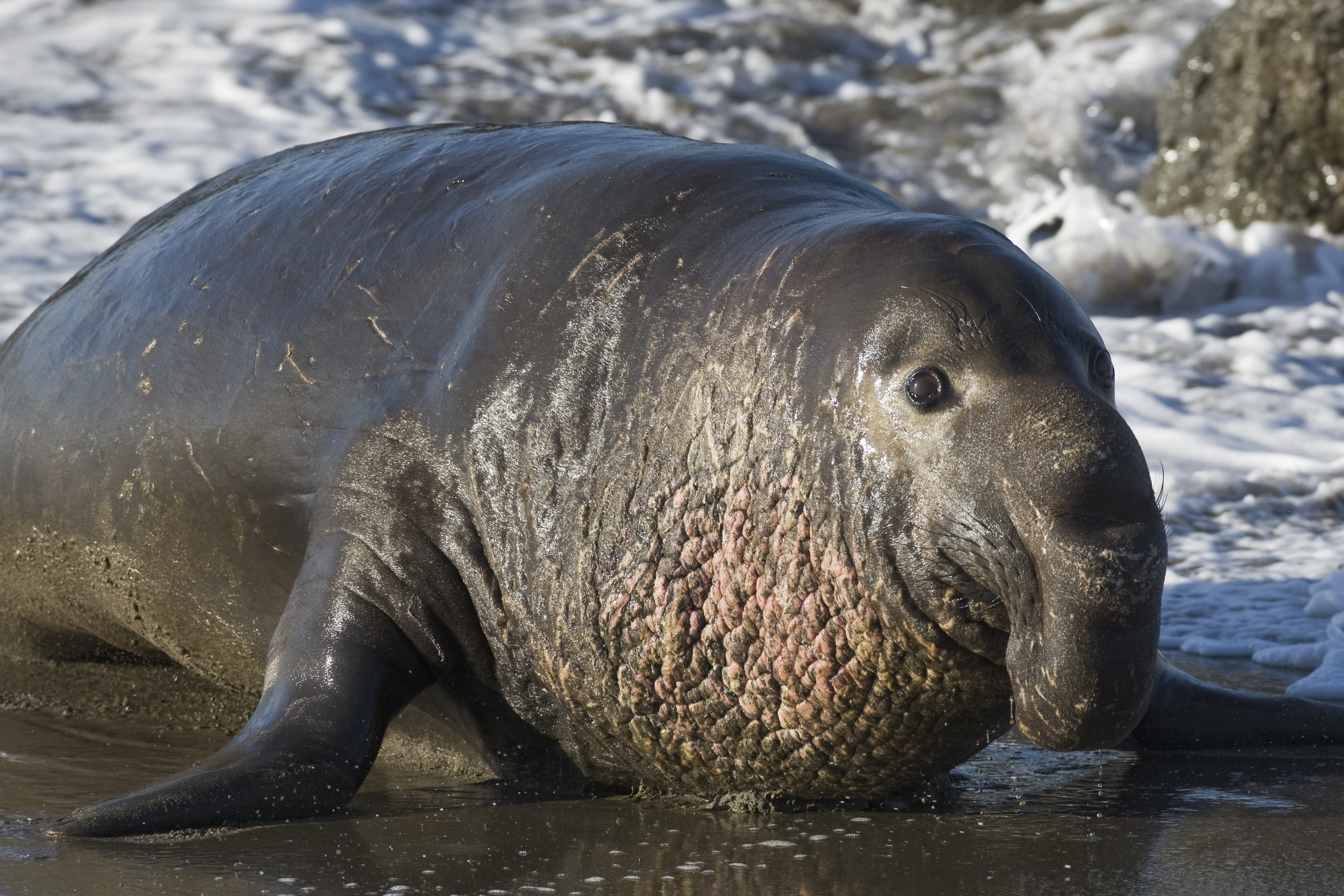
So, back in the US, Smith's group work on parasitic worms found in marine mammals, especially seals. Among other things, they identify them when an infected animal washes up or comes into a rescue centre. However, they're having trouble with one sample of worms. They come from the heart of an elephant seal, but the scientists who found them have identified them as Otostrongylus circumlitus. This species instead lives in the lungs of harbour seals.

I know which one I'd rather parasitise.
Sources: https://pixabay.com/p-18440/?no_redirect
https://upload.wikimedia.org/wikipedia/commons/e/e3/Northern_Elephant_Seal%2C_Piedras_Blancas%2C_San_Simeon%2C_CA_02feb2009.jpg

Is the identification wrong, or is this a cool new host situation, maybe because the worms got into the elephant seal by mistake, got confused, and migrated to the wrong organ? That's what Smith's group want to find out.

Unfortunately, sequencing the DNA of the mystery worms wasn't helpful. The results came out all over the place, which might be true of that whole group of worms. The other way to identify them is good old-fashioned morphology. This is challenging for nematodes because they basically all look like this:


These ones were about 15 mm long but you still needed a microscope to see any, erm, identifiable features. And the worms haven't been preserved in the best of ways so might be damaged at that scale anyway. Tricky.

So, while Smith happens to be doing her internship thing at the NHM, she decided to find some Otostrongylus circumlitus in the collections and take some photos to compare the mystery worms with, because if something is going to be correctly identified anywhere, you'd hope it would be in the NHM collections. Last week, the parasite curator gave us a little jar of O. circumlitus and Smith searched through looking for males. It turns out that this group of nematodes does have one identifiable feature: the male tail. It's a sort of fan/sucker thing used for mating, like a tiny frilly collar on the very end of the worm. Once she'd found a couple of males, they went into a little dish of creosote (of all things: https://en.wikipedia.org/wiki/Creosote), which would eventually turn them translucent so that we could see them in detail.

We went back to have a look this afternoon. The creosote had certainly worked. Smith did the neat trick of taking photos through the microscope eyepiece. Here's one worm's head with all of the weird bunchy tissues and bits:

And here's the tail with a side-on view of the transparent frilly collar thing:

Fortunately, there are people (and books) that know what these tiny wibbly jelly tail prong bits mean. The photos have all been sent off to the US to compare to the mystery worms. We'll see if anything comes of it.

Monday, 5 June 2017

Scientist in action

Today, I present a photo of myself undertaking a delicate scientific operation: the pouring of about half a cylinder of fairly inert liquid into a plastic box:


 Smith kindly took it so I could post a printout to my Nan, who doesn't have access to the Internet. So I anonymised it for the blog using my favourite PCR machine.

In other news, I was out in public this morning for nearly two hours with my shirt on inside-out.


Image source (this was blocked by my university, so beware): https://www.google.co.uk/url?sa=i&rct=j&q=&esrc=s&source=images&cd=&ved=0ahUKEwigkeSAkqbUAhXDWxQKHRnYCesQjBwIBA&url=http%3A%2F%2Fwww.p-n-f.com%2Fen%2Fimages%2Fthermalcycler.jpg&psig=AFQjCNGKoIT2o6NvGi6dOTIlJ_9Y6p9Y4A&ust=1496732699529221&cad=rjt

Thursday, 1 June 2017

Further poo developments and my first go at grave digging

So, for the past couple of weeks I've been honing my molecular biology skills on some samples of waterfowl excrement. The aim was to extract the DNA from them, quantify it, and if there was enough, run it through a PCR reaction that would pull out any parasite sequences. This would tell us whether those birds had these particular parasites.

The first lot, a mixture of teal and mallard, had mixed results and I was worried it was down to my technique. Since 2014 would't have touched molecular stuff with a bargepole; this project was a rather spontaneous choice. But we finished running some new samples yesterday (from pink-footed geese) and they were more successful. Crucially, they were also quite consistent. So hopefully we can put the dodgy ducks down to being dodgy samples.

With the training montage more or less finished, yesterday afternoon I got to work with the samples for my project at last. We'd also been waiting for space in a special clean lab: the Russian grave soil has been sitting dry in sealed bags for years, but we didn't want to presume our colleagues would be okay with us spilling it over their workspace.

There were ten little paper envelopes, each with a small handful of soil. We picked one, poured it into a petri dish and filled up eleven DNA-extraction tubes, avoiding the big chunks of plant. One extra tube we saved for a particularly interesting lump. It was about two centimetres long, rod-shaped and a bit lumpy, and we have absolutely no idea what it was. My guess is an odd bit of root, but we excitedly labeled the tube as 'Finger' anyway. We want to eventually sequence all of the DNA anyway, so it will be interesting if we can match tube 12 to anything.

Finally, last week our little team increased from two to three. Me and Supervisor have been joined by Smith, an American student from the eponymous college with a background in parasitic worms of marine mammals. She's over here for a bit of summer fun helping out with worm research at the NHM. For the time being at least, she's helping me with labwork. Even if our methods are a bit different to what she's used to, she is very experienced and a dab hand with a pie-pette. A welcome addition.